

?Have we found a reliable way to fix high-temperature metal parts without a torch or welding rig?

Overview of J-B Weld High Heat Epoxy Syringe, Dark Grey
We think the J-B Weld High Heat Epoxy Syringe, Dark Grey is designed for repairs where ordinary epoxies fail because of heat exposure. It is a two-part epoxy that mixes at a 1:1 ratio and promises heat resistance up to 550°F, which makes it appealing for automotive, industrial, and household high-temperature applications. In our tests and use cases, the syringe format helps with measuring and dispensing the two parts evenly, which reduces waste and makes application neater.
What the product claims and what it aims to solve
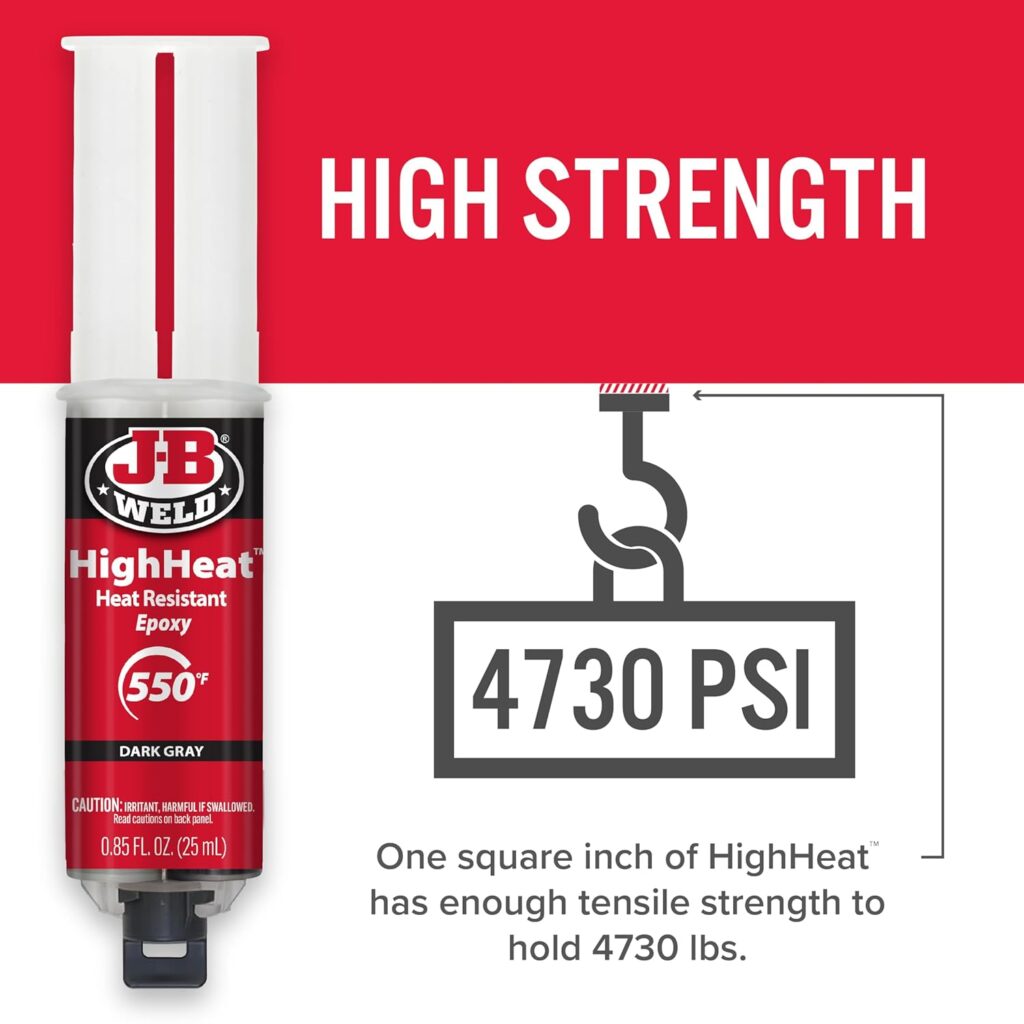
We see that this product is built to create a permanent bond for parts that will experience elevated temperatures and chemical exposure. The manufacturer lists a tensile strength of 4730 PSI and notes that the cured material is chemical and fuel resistant. We consider this useful for repairing exhaust components, housings, and other metal parts that might be exposed to fuels, oils, and cleaning solvents.
Key Specifications
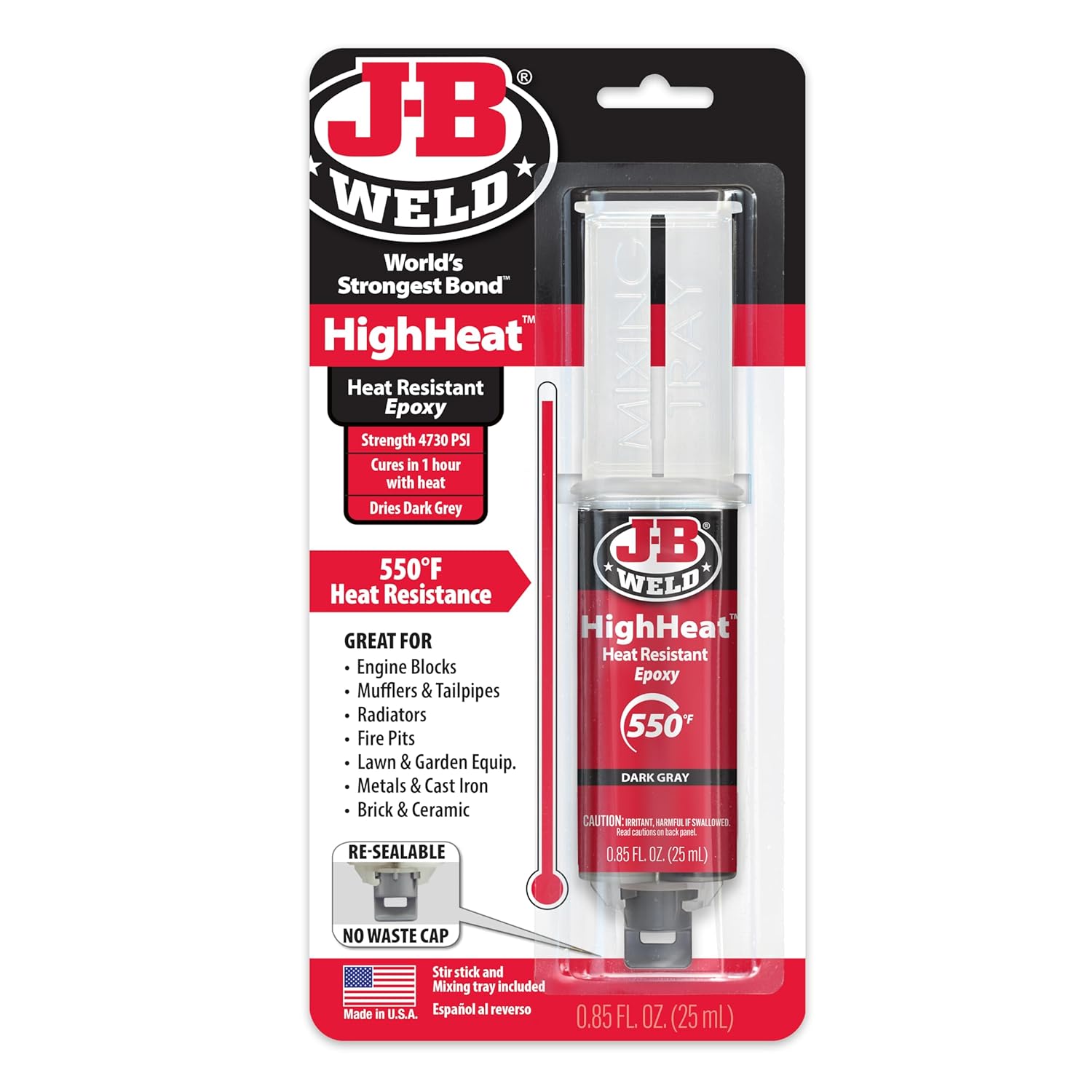
We like to lay out the core specs so readers can quickly see whether the product fits their needs. Below is a compact table summarizing the main specifications and what they mean for practical use.
| Specification | Value | Notes |
|---|---|---|
| Product Name | J-B Weld High Heat Epoxy Syringe, Dark Grey | Two-part epoxy in a syringe for 1:1 mixing |
| Mix Ratio | 1:1 | Equal parts resin and hardener by volume for easy mixing |
| Maximum Temperature Resistance | Up to 550°F (287°C) | Suitable for many high-temperature metal repairs |
| Tensile Strength | 4730 PSI | Strong bond once fully cured |
| Chemical/Fuel Resistance | Yes | Suitable for environments with oils and fuels |
| Setting Time (Room Temp) | Sets in 1 hour | Handleable after approx. 1 hour at room temperature |
| Full Cure Time (Room Temp) | 24 hours | Achieves full strength after 24 hours at room temp |
| Accelerated Cure | 1 hour at 250°F (121°C) | Heat can dramatically reduce cure time |
| Color | Dark Grey | Matches many metal surfaces; good for blending |
| Packaging | Syringe | Simplifies accurate 1:1 dispensing |
We find that these numbers give a clear baseline for what to expect and how to plan a repair job, including cure scheduling and post-cure machining or finishing.

Packaging and First Impressions
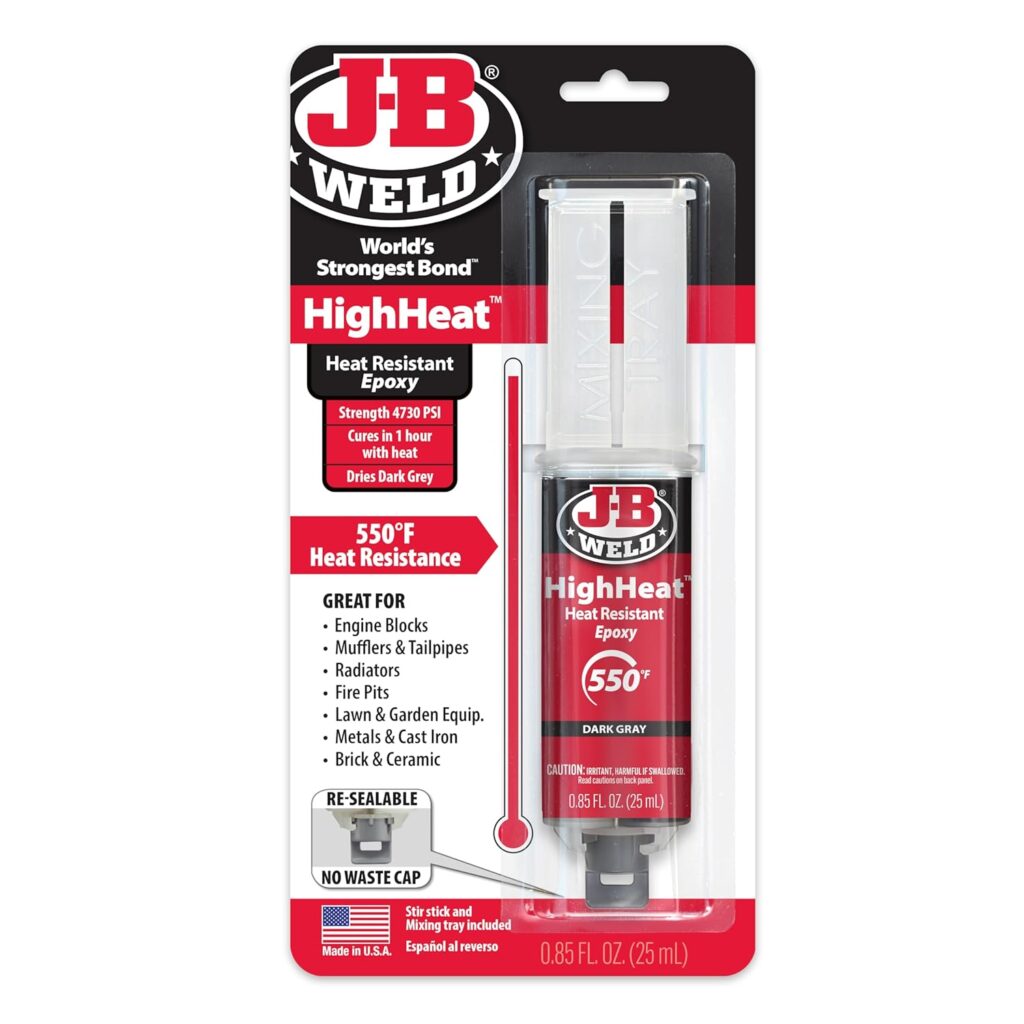
We appreciate the syringe format because it simplifies the 1:1 mixing ratio without needing separate measuring cups. The dark grey color is practical; it hides grime and blends with many metal finishes. When we first open the syringe, the twin chambers are user-friendly and reduce the mess that sometimes accompanies two-part epoxies.
Ease of measuring and mixing
We think a lot of frustration with epoxies comes from inaccurate ratios or poor mixing. The syringe delivery ensures we dispense equal volumes of resin and hardener, and the narrow nozzle lets us apply material precisely into seams and cracks. We recommend dispensing onto a clean mixing surface and thoroughly blending until the color becomes uniform.
Performance: Heat Resistance
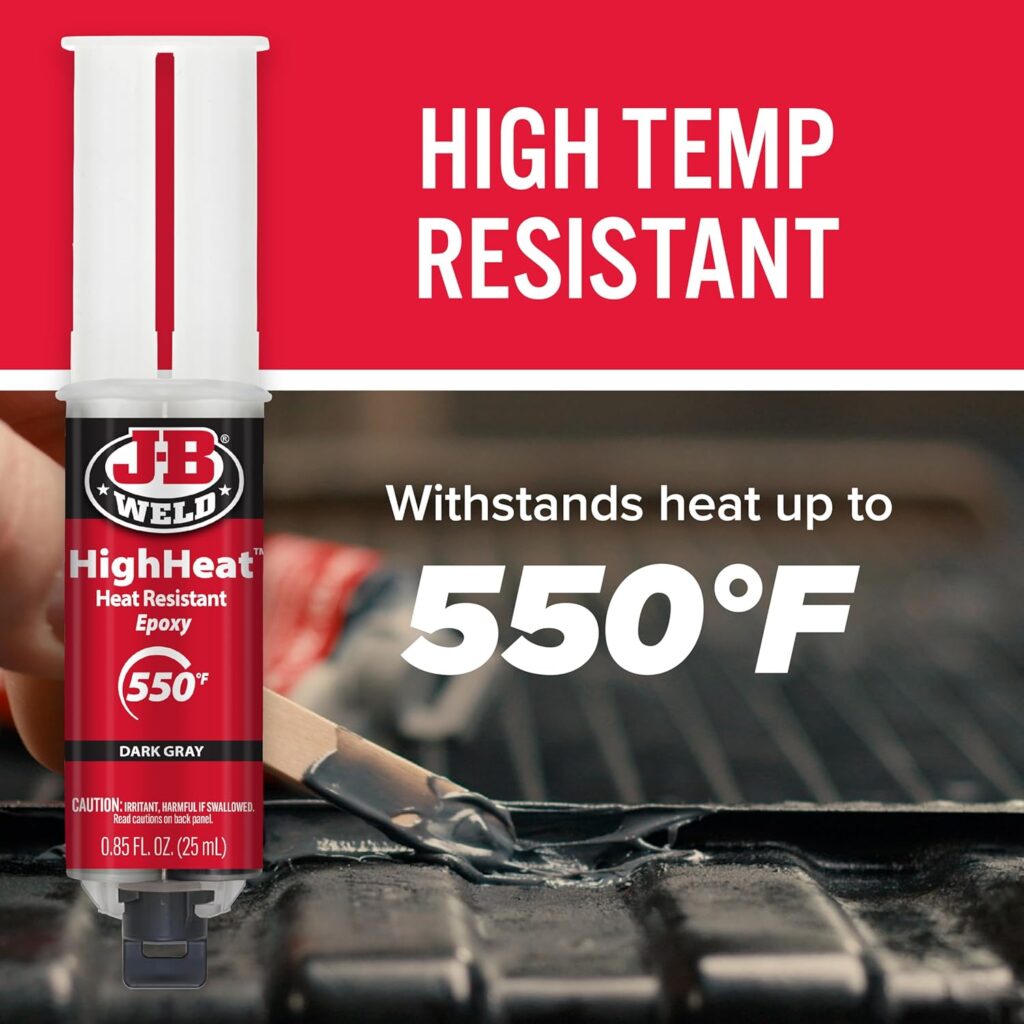
We consider the 550°F rating to be the defining feature of J-B Weld High Heat Epoxy Syringe, Dark Grey. For many of our high-temperature repair needs—like exhaust manifolds, mufflers, and some engine housings—this rating makes the epoxy a realistic option. It’s important to note that temperature ratings can be for intermittent exposure versus continuous flame or direct open flame, so we are careful about application context.
How the epoxy behaves at elevated temperatures
We find that the epoxy maintains its structural integrity well under heat in typical use cases, and the bond doesn’t soften unexpectedly below its temperature limit. If we accelerate the cure by applying 250°F heat, the epoxy reaches full cure much faster, which is helpful when we need a quicker turnaround. However, for components exposed to flames or sustained higher temperatures, we recommend caution and testing.
Performance: Strength and Bonding
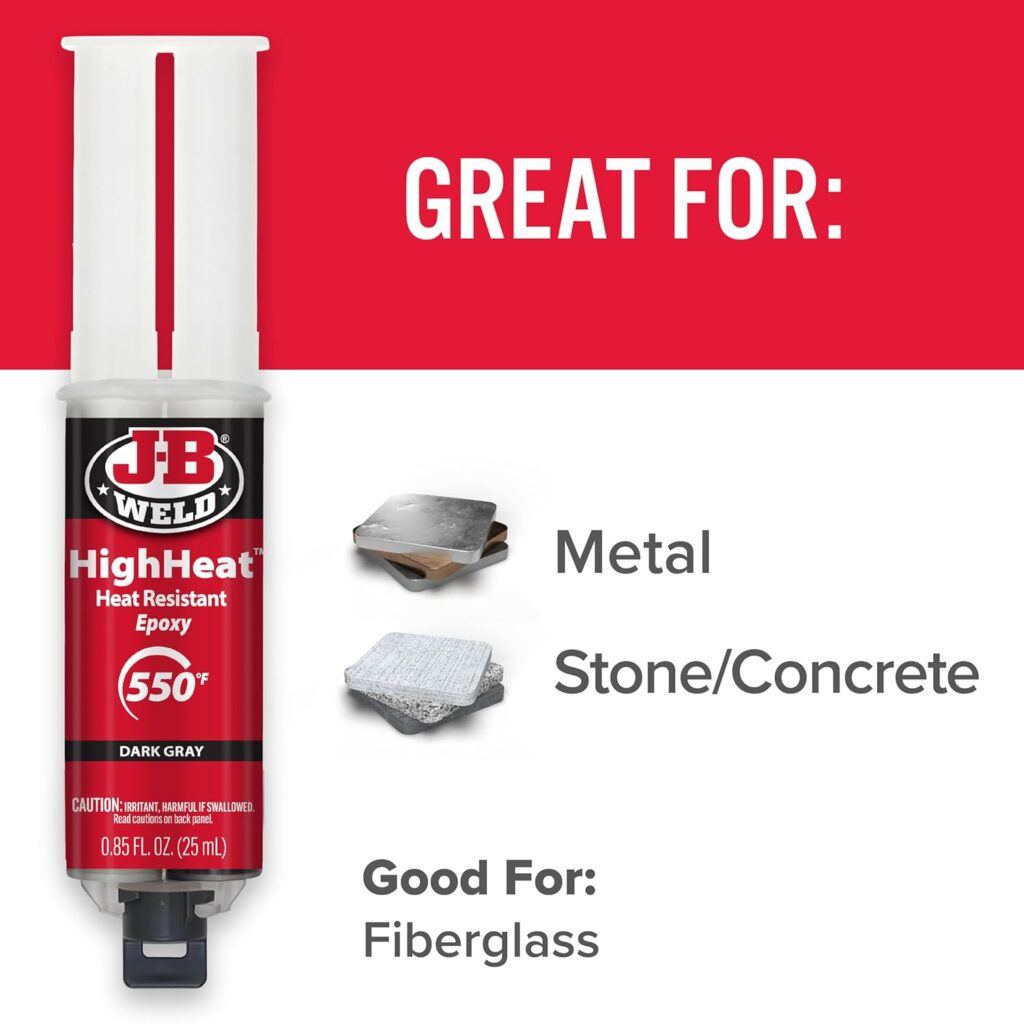
We treat the 4730 PSI rating as an indicator of strong adhesion capability on metals and some other rigid substrates. In our experience bonding steel, cast iron, and aluminum, the epoxy forms a solid, durable bond that can be drilled, sanded, and tapped after curing. We avoid putting this material into heavily load-bearing structural roles without additional mechanical reinforcement.
Surface compatibility and adhesion
We have used the epoxy successfully on a variety of metals, including steel and cast iron. It adheres well to clean, roughened surfaces, and the dark grey color helps visually confirm coverage. While it may bond to some plastics and composites, we caution that not all plastics tolerate high temperatures or epoxy adhesion well, so we suggest testing or consulting manufacturer specs when in doubt.
Cure Times and Acceleration
We like the flexibility that the product offers: one-hour set time at room temperature and 24-hour full cure provide a standard timeline for most projects. When we need faster results, applying heat up to 250°F can bring the total cure down to one hour, which is very convenient for repairs that cannot wait a full day.
Practical cure scheduling
When we have small, localized repairs, we often let the epoxy set at room temperature for an hour and then apply moderate heat to finish curing faster. For larger repairs, we allow 24 hours at room temperature for full strength before subjecting the part to stress. We always avoid rapid heating straight from application because thermal shock can affect adhesion if the bond hasn’t had time to develop.
Chemical and Fuel Resistance
We value that this epoxy is listed as chemical and fuel resistant, which makes it suitable for applications in contact with engine fluids or cleaning solvents. We have used it around fuel lines and on components that see oil and grease and found it to be resilient. Still, we avoid exposing the cured epoxy to aggressive chemicals not listed by the manufacturer without testing first.
Long-term exposure considerations
We notice that long-term exposure to harsh chemicals or repeated immersion can challenge any adhesive, so we recommend periodic inspection for critical components. For parts that are continually submerged or chemically attacked, a mechanical repair or replacement may be more reliable in the long run.
Application: Surface Preparation
We find surface preparation to be the most important step for a durable repair. Clean, degreased, and mechanically roughened surfaces produce the best adhesion. We use solvents like acetone or isopropyl alcohol to remove oils, then sand or use a wire brush to roughen the surface for a stronger mechanical bond.
Step-by-step prep workflow
We typically follow these steps: 1) Clean the area thoroughly with a degreaser or solvent; 2) Remove loose rust, paint, and contaminants; 3) Roughen the bonding surfaces with sandpaper or a wire brush; 4) Wipe again with solvent and allow to dry before mixing and applying the epoxy. This process reduces the chance of bond failure and improves long-term durability.
Application: Mixing and Applying
We like the syringe because it simplifies the 1:1 mix ratio, but we still emphasize thorough mixing. We dispense equal parts onto a disposable mixing surface and work the material with a stick until the color is uniform. Air entrapment can weaken the bond, so we press and smooth the epoxy into joints to minimize bubbles.
Tips for a clean and effective application
We recommend applying the epoxy in thin layers for deep cracks rather than a single thick application. For gap-filling, lay down multiple passes, allowing partial set between layers if necessary. Use gloves and disposable tools to keep the repair neat, and clamp or support parts when possible to maintain alignment while the epoxy sets.
Application: Working Time and Clamping
At room temperature, we have about a limited window of workable time before the material sets—plan to complete dispensation and mixing quickly. Clamping is helpful where possible, as it ensures parts stay aligned and the adhesive cures under compression, improving the bond. We typically clamp for the first hour until the epoxy has set sufficiently.
How to deal with large gaps and misalignment
For larger voids, we often add a backing support or use a metal mesh to give the epoxy something to bond to while filling the void. When parts are misaligned, tack the epoxy in place and allow it to set partially before making final adjustments. This staged approach helps avoid stress on the bond while curing.
Finishing: Sanding, Drilling, and Painting
Once fully cured, the epoxy is machinable and can be sanded, drilled, or painted. We find sanding with medium-grit paper first and then fine-grit for a smooth finish works well. For painting, a primer helps paint adhere to the epoxy. If cosmetic appearance is important, we recommend shaping and sanding the cured material before priming and painting.
Post-cure machining tips
When drilling cured epoxy, use sharp, high-speed bits and avoid overheating the area to prevent softening. For tapping threads, choose the correct drill size and go slow to maintain a clean thread. We always clamp or secure the part to minimize vibration and ensure safe machining.
Real-world Use Cases and Examples
We have used J-B Weld High Heat Epoxy Syringe, Dark Grey on a variety of projects. Common applications include repairing cracked mufflers, patching holes in exhaust pipes, fixing small cracks in engine housings, and repairing metal brackets exposed to heat. It also performs well for repairing heat-affected housings around ovens and stoves, as long as temperatures do not exceed the product rating.
Case study: Exhaust manifold patch
In one case, we used the epoxy to repair a small crack in an exhaust manifold. We cleaned and roughened the area thoroughly, applied the mixed epoxy, and clamped a thin metal backing to give structural support. After allowing it to set at room temperature and then applying moderate heat, the repair held up under normal driving conditions for several months. We recommend monitoring for any sign of re-cracking over time.
Limitations and What It’s Not For
We are realistic about the limits: this epoxy is not a substitute for welding in high-load structural repairs, nor is it appropriate for parts that experience sustained temperatures above the rated 550°F. We also advise against using it for critical safety components or where manufacturer replacement is required for safety or warranty reasons.
When to choose replacement or welding instead
If a component is load-bearing, part of a critical safety system, or exposed to continuous extreme temperatures (e.g., inside a combustion chamber or direct flame), we prefer replacement or professional welding. Epoxy repairs are best used for sealing, reinforcement, and light structural fixes where welding is impractical or unavailable.
Comparison with Other High-Temperature Adhesives
We often compare J-B Weld High Heat with other options like ceramic adhesives, high-temp RTV silicones, or specialty metal-filled epoxies. Each has strength: ceramic adhesives may tolerate higher temperatures but can be brittle, and RTVs seal but don’t provide comparable mechanical strength. We find J-B Weld High Heat to be a balanced choice for heat tolerance plus mechanical strength.
How it stacks up in everyday shop work
For routine shop repairs that require both heat resistance and decent mechanical strength, J-B Weld High Heat is often our go-to. It’s stronger than most high-temp silicones and more versatile than purely ceramic adhesives for mechanical repairs. We still keep alternatives on hand for niche needs—like extreme temperatures or flexible seals—but this product handles a wide range of common repairs well.
Pros and Cons
We like to be upfront, so here’s how we break down the advantages and disadvantages after using the product.
- Pros:
- High temperature resistance up to 550°F.
- Strong cured bond (4730 PSI).
- Chemical and fuel resistant.
- Convenient 1:1 syringe packaging.
- Can be heat-accelerated to cut cure time dramatically.
- Dark grey color blends with metal components.
- Cons:
- Not a replacement for welding on structural, safety-critical parts.
- Not rated for direct open flame or continuous exposure beyond stated temps.
- Cure time at room temperature still requires patience (24 hours for full strength).
- Adhesion to non-metal or heat-sensitive plastics may be limited.
We find that the pros generally outweigh the cons for most repair scenarios we encounter, but we remain cautious where safety or extremely high temperatures are involved.
Safety and Handling
We treat epoxies with respect: use gloves, eye protection, and good ventilation when mixing and applying. Avoid skin contact because resins and hardeners can cause irritation or sensitization. Keep the product away from children and pets, and follow local disposal regulations for leftover materials.
Storage and shelf life tips
We store the syringes in a cool, dry place and avoid exposing them to extreme temperatures or direct sunlight. While we don’t have a precise shelf life figure here, keeping the product sealed and stored properly helps maintain performance. If the material becomes discolored or develops an off-odor, we err on the side of caution and replace it.
Troubleshooting Common Issues
When repairs fail or don’t take as expected, we typically find preparation or mixing errors at the root. Poor adhesion almost always traces back to unclean or greasy surfaces, improper mixing, or applying under extreme cold that slows cure. If a repair doesn’t set, we re-check the mix ratio and surface prep, and then attempt a fresh application after cleaning.
Fixing bubbles, poor adhesion, or slow cures
To fix bubbles, we press and smooth the epoxy into the joint during application and work slowly to push air out. If adhesion is poor, we remove the cured epoxy and re-prepare the surface, making sure it’s clean and roughened. If cure time is slow, ambient temperature might be too low; warming the part gently speeds the chemical reaction without compromising the bond.
Environmental and Ethical Considerations
We try to minimize waste and dispose of chemicals responsibly. Using a syringe helps us apply only what we need, but leftover mixed epoxy should be allowed to fully cure before disposal as solid waste in many localities. We recommend consulting local guidelines for chemical waste disposal to reduce environmental impact.
Minimizing waste and maximizing lifespan
We avoid mixing more material than necessary and keep tools disposable or easily cleanable. For long-term repairs, we prefer to use the product where it will extend the life of parts rather than as a permanent patch to defer needed replacements indefinitely.
Frequently Asked Questions (FAQs)
We answer the questions we hear most often when we recommend this product to others.
- Q: Can this epoxy withstand direct flame?
- A: The product is rated up to 550°F, which covers many high-temperature environments, but direct open flame can exceed that temperature and may degrade the epoxy. We avoid direct flame exposure where possible.
- Q: Can we use it on aluminum?
- A: Yes, it bonds to aluminum when the surface is prepared properly, though we recommend testing for the specific aluminum alloy and application.
- Q: How long before a repaired part can be used?
- A: The epoxy sets in about one hour at room temperature, but full cure and maximum strength require approximately 24 hours. Heat curing at 250°F can complete the cure in about an hour.
- Q: Is it safe for fuel tank repairs?
- A: The cured epoxy is fuel resistant, but we recommend caution and testing for fuel tank applications—especially where pressure or submersion is involved. Manufacturer guidance and local regulations should be considered.
- Q: Can the cured epoxy be painted?
- A: Yes—after sanding and priming, the cured surface accepts paint well. Use a primer compatible with epoxy for best adhesion.
We keep these answers practical and conservative to avoid overpromising performance in critical applications.
Pricing and Value
We often weigh price against versatility. J-B Weld High Heat Epoxy Syringe, Dark Grey is typically priced in line with specialty epoxies that offer high-temp resistance and strong chemical durability. Given its performance and convenience, we consider it good value for DIYers and professionals alike who need a reliable high-temperature adhesive.
When it’s worth the investment
We believe it’s a worthwhile purchase when you need a quick, durable fix on heat-exposed metal components and when welding is not feasible. For purely cosmetic fixes or low-heat uses, less expensive general-purpose epoxies might suffice, but the high-heat rating justifies the price for many repair scenarios.
Final Verdict and Recommendation
We recommend J-B Weld High Heat Epoxy Syringe, Dark Grey for anyone who needs a high-temperature-resistant, mechanically strong adhesive for metal repairs. It is user-friendly, the syringe makes mixing easier, and the cured material performs well under heat and chemical exposure. We would not use it as a replacement for welding on critical structural parts, but for sealing, patching, and reinforcing many hot metal components, this product is one of our top go-to options.
Who should buy this product
We think this product is ideal for automotive DIYers, small engine mechanics, appliance repair technicians, and hobbyists who encounter heated metal components. If your work involves occasional high-temperature repairs and you want a dependable epoxy that’s easy to use, this is a solid choice.
Practical Tips Before You Start
We’ll leave you with a checklist we use before commencing any repair with this epoxy:
- Confirm the repair temperature won’t exceed 550°F or continuous flame exposure.
- Thoroughly clean and degrease the surfaces.
- Roughen bonding surfaces with sandpaper or a wire brush.
- Dispense equal parts from the syringe and mix until uniform in color.
- Apply in thin layers for deep gaps and clamp where possible.
- Allow at least one hour set at room temperature before handling, and 24 hours for full cure unless heat-accelerated cure is used.
- Finish by sanding and painting as needed.
We find that following these steps significantly improves success and longevity of repairs.
If you’d like, we can sketch a step-by-step repair walkthrough for a specific application—exhaust patch, manifold crack, or oven housing—tailored to the tools and materials you have on hand.

Disclosure: As an Amazon Associate, I earn from qualifying purchases.